The complete mechanics of entering a Japanese love hotel
From the street outside to the moment the door closes behind you — every step, every decision point, every unspoken rule. Longer than a blog post, shorter than a manual.
Japan's love hotels are set up so that the people using them never have to explain themselves to anyone, and yet the system still works. This is a complete account of how, for someone who has never seen one in person.
Spotting one from the street
Love hotels are usually identifiable from the exterior. The building is often elaborate — castles, pirate ships, stark white towers with small pink lights at each window. The entrance is recessed, sometimes behind a privacy screen, sometimes down a short staircase. There is rarely a "hotel" sign in English; the English signage, if any, reads "Rest" and "Stay" with prices beside them.
The ones concentrated in Maruyamacho and Dogenzaka, Shibuya, are the largest cluster in central Tokyo. Ebisu has a quieter, more design-forward set. Ueno and Uguisudani have older, sometimes roomier ones that haven't been renovated in twenty years.
The entrance hall
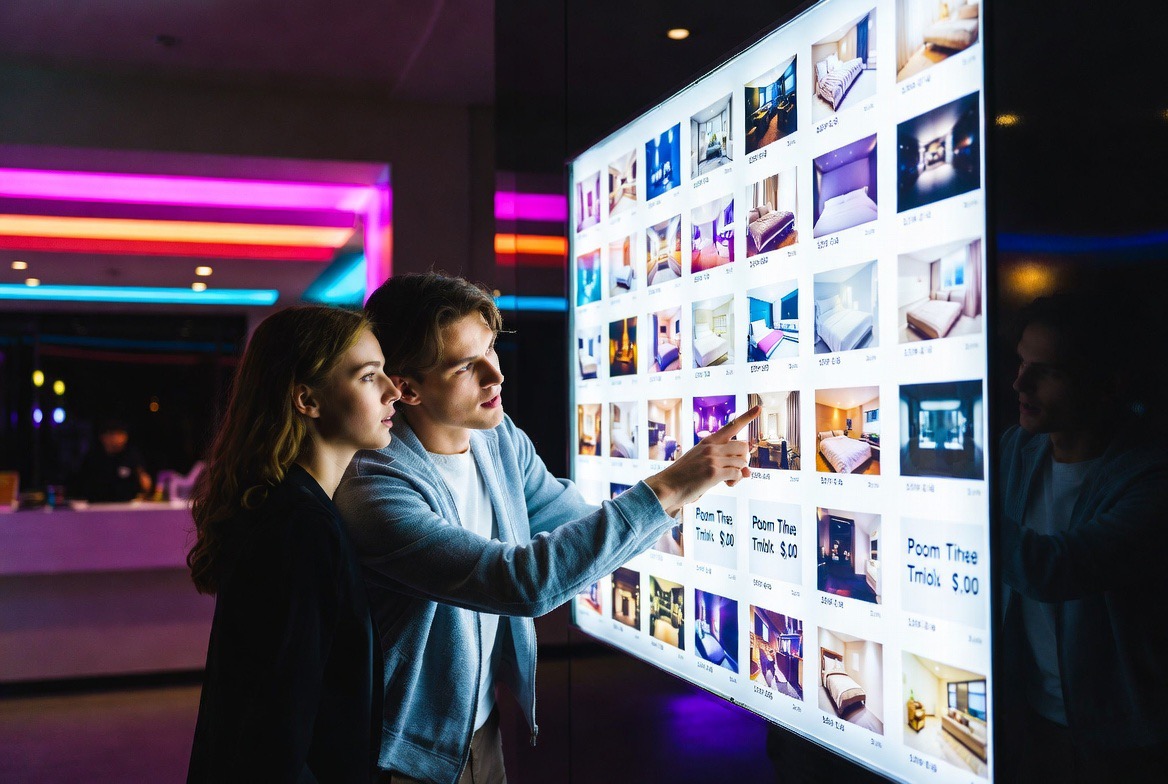
Inside, the first thing you'll see is the selection panel — a wall-mounted touchscreen, usually backlit in soft pink, showing photographs of every available room. Each room shows two prices: Rest (typically 2–3 hours) and Stay (overnight, usually 22:00 to 10:00). If a room's photograph is darkened or marked in red, it's taken; pick another.
The panel will often have an English toggle. If not: green-photo = available, red = taken.
Selecting
Tap the photograph of a room you like. The panel shows features — jacuzzi, karaoke, projector, VR setup, theme — and confirms the price. Confirm your selection. Some hotels ask you to insert cash immediately; most let you pay at the end.
A slip of paper prints out with your room number, or a key appears via one of the methods below.
The key handoff
The method varies by hotel.
- Pneumatic tube. A small cylinder descends from a hole in the wall with your key inside. The most futuristic option.
- Counter with frosted window. A hand places your key on the counter, no face visible.
- Self-service locker. The panel tells you which locker to open. Your key is inside.
- Staffed counter. A person hands you the key. Rare in Shibuya, more common in older inn-style hotels.
The corridor and elevator
The corridors are usually narrow and deliberately dim. Elevators often have frosted or mirrored walls so you don't meet other guests by accident. In some hotels each room has its own private outdoor entrance.
Inside the room
Rooms vary wildly — that's the category's selling point. Most include a jacuzzi or deep soaking tub, a large bed, a themed decorative scheme, and a small tablet or control panel that manages lights, music, sometimes air conditioning.
There's usually a menu for snacks and drinks; ordering is by pressing a button or using the tablet. Note: items listed by the bed on laminated cards are usually not complimentary. Read the prices.
The payment pod
When you're ready to leave, use the small device near the door. It calculates what you owe — your room rate, plus any amenities purchased, plus any extension time if you stayed past your original booking.
Payment options depend on the hotel. Most take cash, the nicer ones take domestic cards, some accept IC cards (Suica, Pasmo). Foreign credit cards are hit-or-miss — bring at least ¥20,000 in cash as a safety net.
Insert your payment; the door unlocks; you leave.
Leaving
The door you exit from is often not the door you entered through. This is intentional — the design keeps exits discreet. Even in hotels with a single entrance, the elevators usually empty into a short corridor that bypasses the lobby.
You will not meet anyone on the way out.
Unspoken rules
Two people at a time is the universal standard. Solo travelers are sometimes turned away, sometimes accepted — it varies. Groups of three or four are not supported by most check-in systems; don't try.
Same-sex couples are increasingly welcome, especially in Shibuya and Ebisu, but not universally. If a hotel turns you away, the next one over will take you. It's that kind of neighborhood.
Tattoos are not an issue in love hotels. (They are in onsen and some business hotels.)
Summary
Panel → slip or key → corridor → room → pod → door. The entire choreography is designed so that two people can enter, spend time, and leave, without ever acknowledging a third party. Once you've done it once, you've done it. The rest is preference.