A brief cultural history of Japan's love hotels
From edo-period tsurekomi yado to the neon-lit automated hotels of Shibuya's hill. A compressed four-century arc of how Japan came to accommodate short-stay privacy at scale.
The modern Japanese love hotel has antecedents that reach further back than most foreign visitors realize — farther than the neon, farther than the themed rooms. This is a compressed cultural history.
Tsurekomi yado, 1600 to 1900
The Edo-period institution of the tsurekomi yado — literally "bring-along inn" — was a discreet lodging in the pleasure quarters of major cities, offering short stays for couples who had no practical place to meet. These inns shared an ecosystem with teahouses, the geisha districts, and the licensed yukaku quarters.
The taxonomy of private urban rooms for romantic encounters has been continuous in Japan for at least four centuries. What changed in the modern era was the surface, not the structure.
The postwar gap, 1945–1960
In the decade after the Pacific War, Japan's housing was cramped and often multigenerational. Privacy within the home was functionally nonexistent — thin walls, shared bathing, no individual rooms for young couples. This is the usually-cited economic origin of the modern love hotel: a response to housing density, not to sexual liberation.
The demand preceded the category.
The 1970s boom
The first recognizably modern "love hotel" — standalone building, full rooms-only rental, anonymous check-in — is generally dated to 1968, with Hotel Emperor in Osaka. By 1973 the category had a name. By 1977, an estimated 28,000 such hotels existed across Japan.
Themed rooms became a selling point: rotating beds, mirrored ceilings, sunken baths, imported Italian furniture. The architectural ambition of the 1970s was cinematic — some hotels looked like sets from films that hadn't been made.
The Fuzoku Law, 1984
Amendments to the Businesses Affecting Public Morals Regulation Law — known informally as the Fuzoku Law — placed love hotels under tighter regulation in 1984. Themes deemed "excessive" were banned. Rooms were downsized. Operators rebranded as "boutique hotels" or "fashion hotels" to side-step categorization.
This is the inflection point between the first love hotel era and everything that followed. The rotating beds disappeared quietly.
The 1990s plateau
After the bubble economy collapsed, many themed hotels closed or quietly updated. The extreme concepts — UFO abductions, medieval dungeons, full-scale pirate ships — became nostalgic, photographed by a generation who had not used them.
What survived into the late 1990s was a new sensibility: less cartoonish, more design-conscious. Black lacquer. Minimalist lighting. Architectural water features.
Automation, 2000s
The touchscreen panel, pneumatic tube, and payment pod you encounter today are mostly innovations of the early 2000s, driven partly by labor shortages and partly by deliberate privacy branding. Operators realized that reducing human contact was not only a cost-saving measure but a feature.
This was also when the customer base broadened — younger solo tourists, foreigners, and LGBTQ+ couples, all drawn by the automated anonymity.
The international moment, 2010s
Abenomics-era tourism growth brought millions of foreign visitors to Tokyo annually, and the love hotel quietly became an object of fascination. English-language guides multiplied. Blogs dissected the panel interfaces. Instagram accounts curated the most photogenic themed rooms. Some hotels began actively marketing to foreign travelers — English signage at the entrance, English panels, lists of tips at the check-in station.
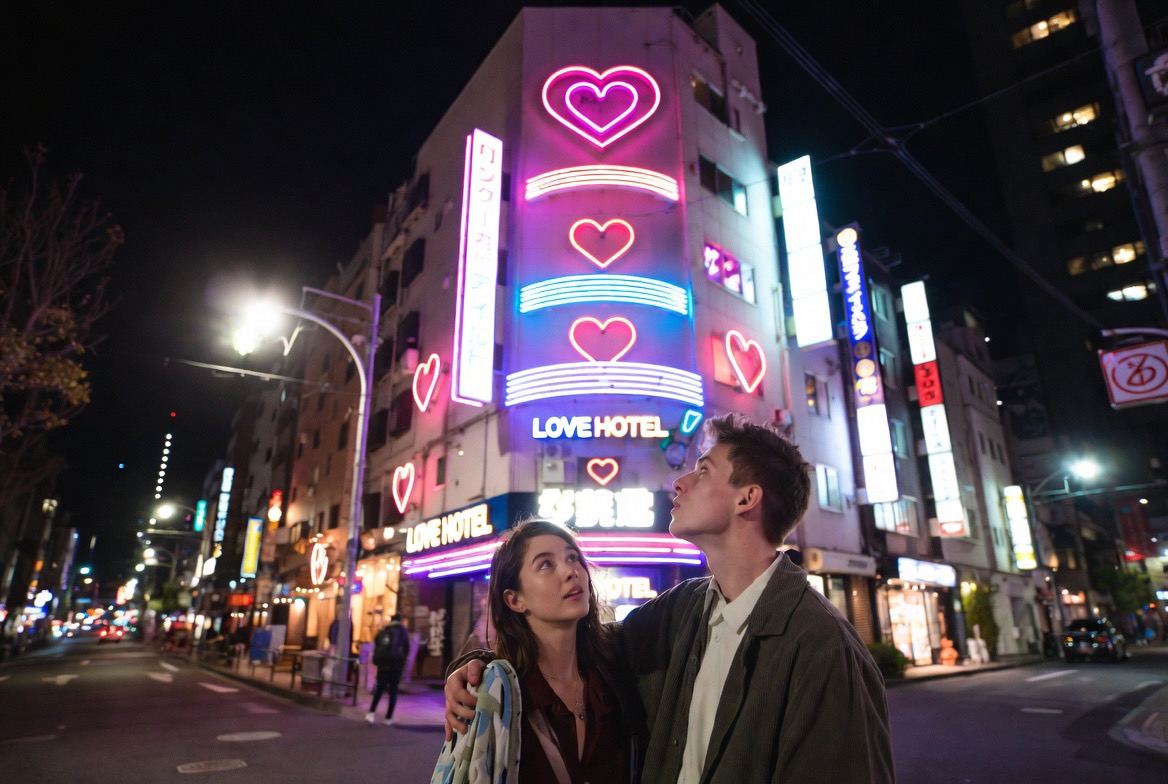
Shibuya's Dogenzaka and Maruyamacho became, to the traveling world, the canonical love hotel neighborhoods. They still are.
Now
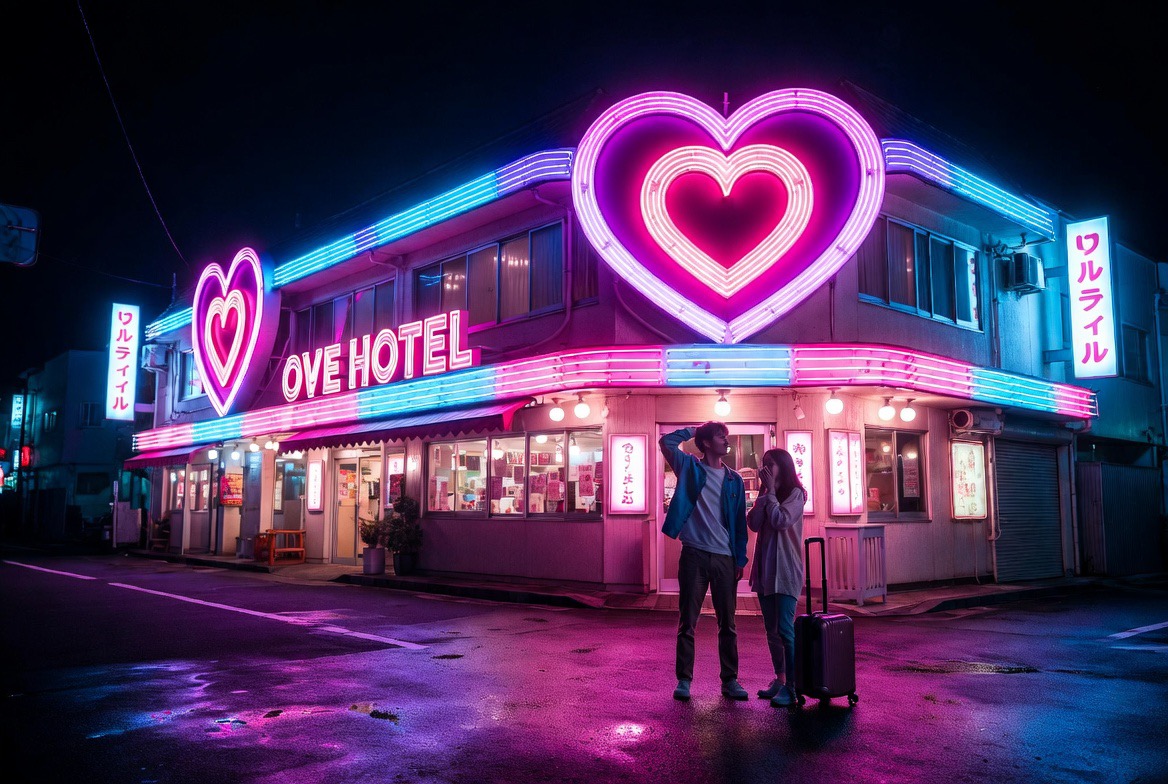
Today's Tokyo love hotel is a design object: polished concrete, projection mapping, private rooftop jacuzzis, playlists curated by the hotel. The theme survives — neon-futurist and retro-showa are the dominant modes — but the palette has shifted from kitsch to pastiche.
Tourists use them more than before. Locals do too. The continuity is what's remarkable: four centuries of private urban rooms, reshaped by each era's economics and aesthetic, still operating at approximately the same function.
What comes next
Some operators are converting buildings into business hotels to serve the inbound tourism boom. Others are doubling down on themed rooms, betting that design-as-experience is a durable category. The most interesting bet is on integration — hotels that are love hotels and business hotels simultaneously, differentiating by who checks in and when.
It's a particularly Japanese response to a universal modern question: what does a city owe its residents' private lives, when everyone around them is watching?
For now, the answer remains: a panel in the lobby, a dimmed photograph, a pneumatic tube, and a door that locks from the inside.